
by Tech Talk | Feb 27, 2023 | Articles
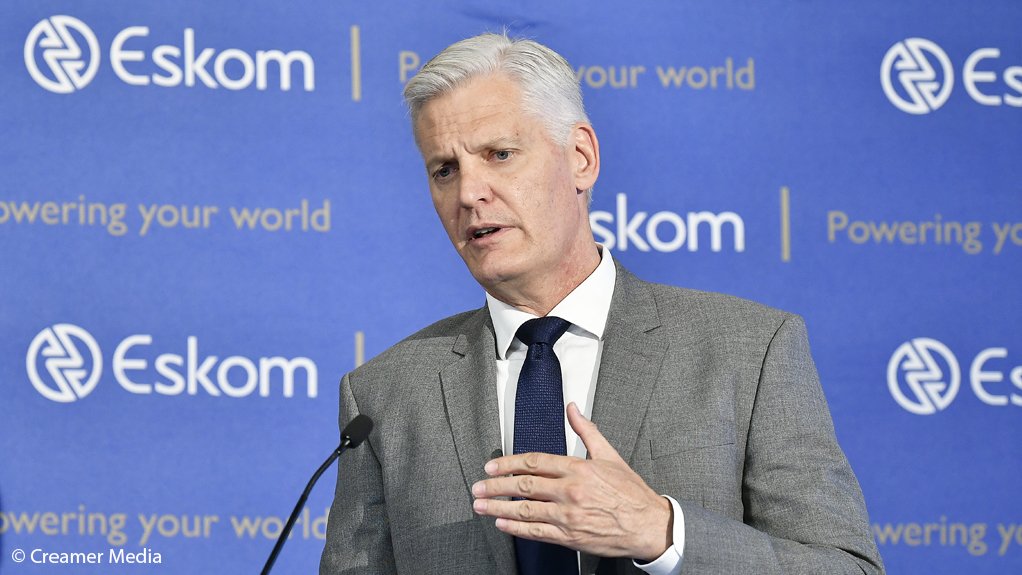
Eskom as announced that chief financial officer (CFO) Calib Cassim will act as group chief executive (GCE) with full delegation of authority with immediate effect and until further notice.
Cassim was appointed as Eskom’s CFO in November 2018 after serving as acting CFO from July 2017. He is a registered Chartered Accountant (SA) and holds a master’s degree in Business Leadership (MBL). He has over 20 years of service in Eskom.
Outgoing GCE Andre de Ruyter has left the utility with immediate effect.
The news comes as Minister of Finance Enoch Godongwana announced new debt relief measures in his budget speech on 22 February 2023.
Government will provide Eskom with R254-billion of debt relief, by:
* Advancing R78-billion in FY 2023/24, R66-billion in FY 2024/25, and R40-billion in FY 2025/26, in each case in the form of subordinated, interest-free loans (convertible into equity) which must be used by Eskom to cover certain capital and interest payments on Eskom’s existing financial indebtedness; and
* Government directly taking over R70-billion of Eskom’s debt portfolio in FY 2025/26, in each case, subject to Eskom satisfying or complying with certain conditions.
Editor@tech-talk.co.za
by Tech Talk | Feb 27, 2023 | Articles
Eskom on Saturday announced that it is positioning itself to play an important role in supporting the development of the electric mobility (e-mobility) sector in South Africa.
Speaking at Africa’s Green Economy Summit held in Cape Town this week, Eskom Group Executive for Distribution, Monde Bala, stated that the organisation has pledged to be part of the anchor market for electric vehicles (EVs) to make a positive contribution towards local market stimulation.
The power utility said it has joined the list of local sponsors for the E-Fest Electric with a R2.1 million sponsorship, which will profile Eskom’s microgrid technology and mobility solution.
Africa’s first consumer clean energy and electric event, E-Fest Electric, is taking place in Cape Town this weekend.
Eskom said that it has already submitted the residential time-of-use (ToU) charging tariff to the National Energy Regulator of South Africa (Nersa) for approval.
This will enable EV owners to achieve significant savings when using the off-peak and standard periods to charge their cars, encouraging EV uptake and boosting electricity sales.
“In line with Eskom’s Just Energy Transition (JET) vision of achieving ‘net zero’ carbon emissions by 2050, we are also aiming for zero emissions from our sizeable fleet of vehicles. We aspire to replace our entire fleet of conventional vehicles with electric vehicles by 2040,” said Bala.
Eskom said it is undertaking a pilot project to introduce electric vehicles, utility and passenger, to the Eskom fleet, which amounts to approximately 13 000 vehicles.
Plans are underway to begin the process of converting the rest of the Eskom fleet to electric where possible.
“We will soon seek suitable partners for the rollout of public charging stations at Eskom sites across the country through the applicable procurement processes. In time, these should be accessible to the public,” said Bala.
Eskom has also announced that it is deploying microgrids that will also support the growth of eMobility in the country, while also serving as an alternative solution to addressing load shedding.
Eskom currently has four sites being powered by the microgrid technology in Ficksburg (Free State), Lynedoch (Western Cape) and Swartkop (Northern Cape), supplying renewable electricity to over 200 households, a police station and businesses in that area.
According to the power utility, it is conducting feasibility studies at more than 80 project sites around the country.
Most of the identified sites will use solar photovoltaic (PV) as the primary source of energy and lithium ion batteries for storage capability.
Other sites will use micro wind turbines and small-scale hydro turbines, based on the most optimum energy source available.
The rollout of these projects will be phased over the next five years.
The deployment of the microgrids in Swartkop and Ficksburg serves as a proof of concept in using of microgrids in remote areas that are difficult to reach or expensive to electrify through the conventional means of electrification.
“On the other hand, the installation of the microgrid at Lynedoch residential area demonstrates how this technology can be used to complement the grid, serving as a backup electricity supply to households, hospitals and other facilities. As an added advantage, microgrids contribute to reducing carbon emissions because they use renewable sources,” the power utility said.
Battery storage, according to Eskom, will also be a key enabler of eMobility.
Eskom is making notable progress in this regard, with the construction of the first energy storage facility under Eskom’s flagship Battery Energy Storage Systems (BESS) project having already begun at the Elandskop BESS site in KwaZulu-Natal in December last year.
Editor@tech-talk.co.za

by Tech Talk | Feb 27, 2023 | Articles
Eastern Cape Premier Oscar Mabuyane has on Friday outlined several priorities for the provincial government, including creating employment which he believes will lead to a flourishing province.
Delivering the province’s 2023 State of the Province Address (SOPA), Mabuyane said the Eastern Cape will this year focus on creating an inclusive economy; providing quality healthcare and education; rolling out basic services such as water, roads, and electricity, and building safer communities.
“This is our contract with the people of our province,” he told the assembly.
The Premier described the year 2022 as “eventful”.
“We had times of hardship but also moments of wonder, that brought great joy in our hearts because they were an affirmation that our efforts of building the Eastern Cape we want are on track.”
Despite these setbacks – including the demise of the 21 youngsters at Enyobeni Tavern – he said he considered 2022 as a year of tremendous progress.
“Our story of good progress begins on the economy because it is the key piece in the puzzle of poverty, unemployment and inequality that we are trying to solve.”
Economy and jobs
The provincial economy is on a path to recovery, after the devastating period of the COVID-19 pandemic, recording growth in the Eastern Cape gross domestic product (GDP) in the first three quarters of 2022.
The number of employed people in the province increased by 144 000 between the third quarter of 2021 and the third quarter of 2022.
“Every day, our minds are occupied by unlocking more opportunities for economic growth, so that women, men and young persons who need a job can get one. Today, I want to assure the people of our province that more jobs are coming.”
He told the Members of the Provincial Legislature (MPL) that last year, the province made history by attracting 11 new investors at the Provincial Investment Conference with a combined value of R46 billion.
These include Shoprite Group, Tshedza Pictures, Transnet Port of Ngqura, Benteler, Sun Farming, South African Breweries, Mhlobiso Concrete, Toyota Material Handling, Sanaha Property Developments, Sanral and Aqora Lithium Battery.
In addition, the newly announced investment projects worth over R1.3 billion are underway with 1 198 jobs created.
The Premier told the assembly that SAB’s Ibhayi Brewery is investing R510 million in plant expansion which will lead to more jobs.
Last year’s new investments take the cumulative total for the sixth administration to R171 billion.
“As a result of these investments, 21 664 people in our province are now employed in various sectors of the economy.”
In the meantime, the province has established an Eastern Cape Economic Development Fund, which will recapitalise private partners to unlock future investments.
He announced that he has tasked the Automotive Industry Development Centre-EC to work with the private sector to implement projects that would prepare them to transition to electric vehicles.
Key among these projects, he said, is the installation of public electric vehicle charging stations in all key routes, enhancement of electric vehicle skills and promotion of renewable energy projects to sustain the demands of the auto sector.
He also said they are establishing an automotive aftermarket programme that will benefit 300 panel beaters and mechanics and will focus on training, capacity building and aftermarket funding over the next three years.
Mabuyane said the province’s two operational Special Economic Zones (SEZ) continue to be a beacon of hope and excellence.
In the last few months, the ELIDZ has attracted R535 million in investment, while the Coega SEZ has received pledges of R557.7 million.
Editor@tech-talk.co.za

by Tech Talk | Feb 27, 2023 | Articles
South Africa and Kenya are worlds apart in their embrace of information technology, but they have one thing in common: they jointly lead the African continent in having the biggest impact of cloud computing on customer experience across 7 major African markets.
This was one of the most significant findings of the final results of the Cloud in Africa 2023 study released this month by World Wide Worx, with support from F5, Red Hat, Dell Technologies, Intel and VMware. The study, based on interviews with 400 information technology decision makers in medium and large organisations across Africa, found that 63% of respondents across the continent had experienced an extremely positive impact on customer experience as a result of cloud computing. In South Africa and Kenya, that number jumped to 71%.
The two countries also shared a high impact on business growth: 51% of South African companies and 46% of those in Kenya reported strong business growth following migration to the cloud.
However, a gulf opened between the two countries when it came to the impact of cloud on innovation. In South Africa, 65% of respondents reported a high impact on innovation, while the proportion dropped to 36% in Kenya.
“Companies often move to the cloud seeking quick wins in the form of improved business efficiency or enhanced customer experience,” says Dion Harvey, regional general manager of Red Hat Sub Saharan Africa. “However, what we tend to see at Red Hat is that true value in the form of real innovation and impact on strategic goals is only realised once they have matured their thinking and approach to cloud.”
Asked what they saw as the biggest benefits of cloud computing in general, companies identified what World Wide Worx CEO Arthur Goldstuck, principal analyst on the research project, calls the cloud’s “golden quartet”: improved security, better customer experience, business efficiency and scaleability.
However, the benefits were not equally distributed. Fewer than half of South African companies, 47%, reported security as a major benefit, compared to an average of 59%. The figure leaped to 78% in Ghana and 63% in Kenya. On the other hand, South Africa led the way in seeing scalability as a benefit, at 47%, compared to an average of 41%. Nigerian companies reflected the lowest response in this regard, at only 29%.
Alain Tshal, district manager of F5 for Sub-Saharan Africa, says that these results underline the extent to which the cloud is not a one-size-fits-all proposition in Africa.
“Every country is at a different level of maturity, and that has a major impact on both immediate benefits of migration and long-term benefits of use,” he says. “South Africa has had the most extensive investment in hyperscale data centres over the past five years of any country in Africa, so it is no surprise to see that it has very different characteristics to most other markets.”
At the same time, where companies have accelerated their investment in cloud computing, the impact is immediately apparent, says Goldstuck.
“The latest findings show that Kenya had the strongest growth in cloud computing in 2022, with a huge 84% of respondents reporting increased spend, compared to an average of 62%,” he says. “South Africa saw 55% of companies increasing their spend. That is partly a consequence of spending already having been high in previous years, compared to countries like Kenya.”
Companies from Malawi, Zambia and Botswana all reported a higher level of increased spend, while Nigeria and Ghana came in just below South Africa. Expectations for 2023 flip around, however. While an overall average of 68% of companies expect to increase spending on cloud services this year, that jumps above 80% for Botswana and above 70% for South African and Nigeria. In contrast, Kenya drops to the bottom of the list this year, with 51% of companies reporting they will increase their spend.
Editor@tech-talk.co.za

by Tech Talk | Feb 27, 2023 | Articles
Acer has been included in Forbes’ list of the World’s Top Women-Friendly Companies in 2022. Forbes cooperated with the market research institute Statista in conducting an anonymous survey of nearly 85,000 women working in multinational companies around the world. The selection of the top 400 companies was based on several gender-related criteria including equal opportunities for career development, public perception, and female representation in corporate ranks. Acer received high marks in terms of its overall image and the proportion of women holding leadership roles, as it gives importance to creating a gender-equal work environment to support the company’s competitiveness.
In 2022, Acer’s female employees accounted for 38% of its total workforce with 31% holding managerial roles. Acer plans to continue attracting outstanding female talent by offering competitive salaries, professional development opportunities, and parental support.
This recognition follows Acer’s being named by Forbes as one of the World’s Best Employers for the third straight year and joining the ranks as one of America’s Best Employers for New Grads in 2022. These accomplishments reflect Acer’s efforts in providing a positive work environment for all its employees and implementing corporate sustainability initiatives.
Editor@tech-talk.co.za
